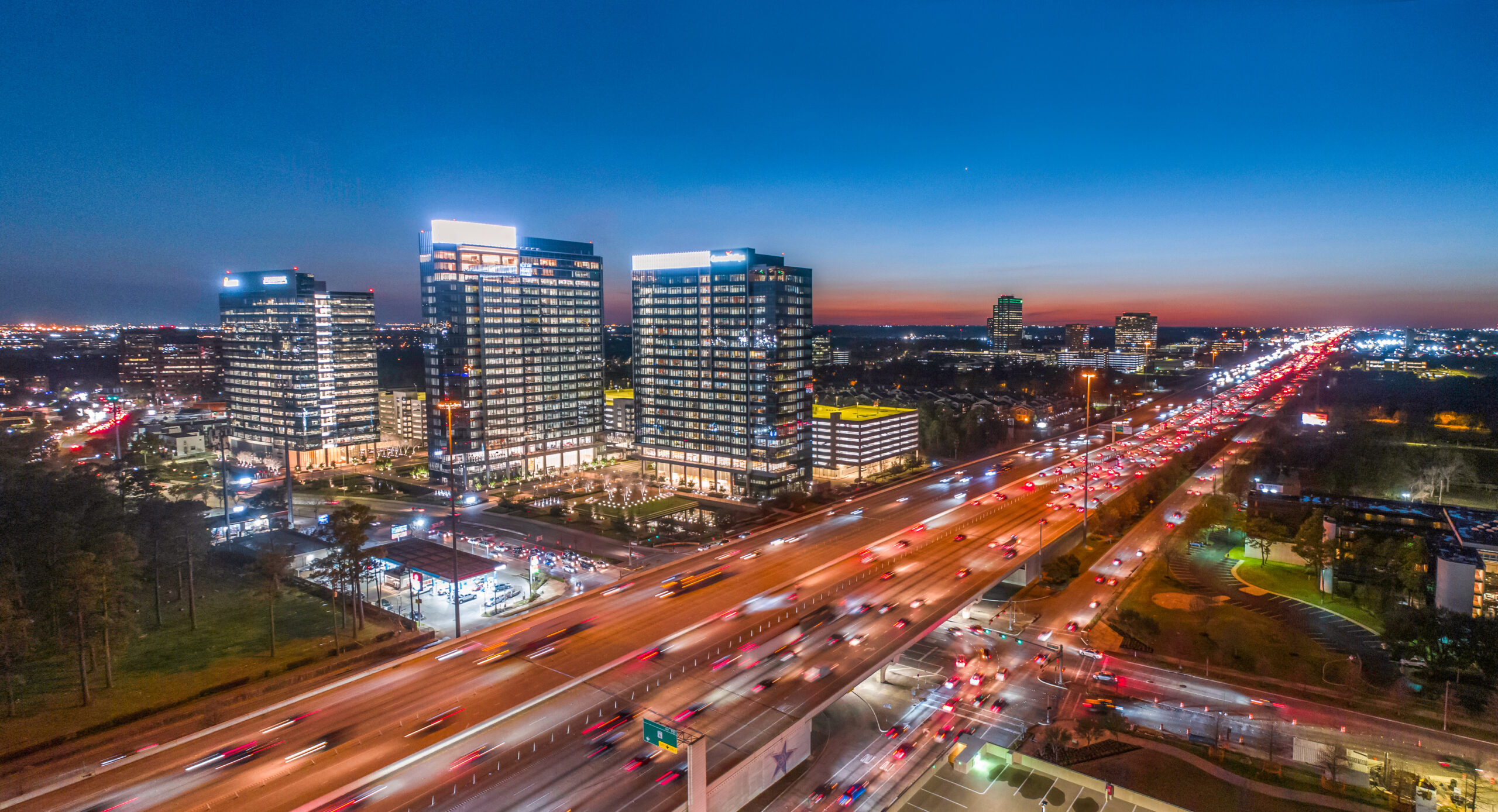
Energy Corridor District Packs Big Economic Punch
The Energy Corridor District continues to prove it is far more than a cluster of office buildings — it is a powerful economic engine driving growth across West Harris County and beyond.
That impact begins with global energy companies headquartered in the District and extends to the businesses that support them. Employers lease Class A office space, pay competitive wages and fuel a cycle of economic activity that reaches into surrounding neighborhoods. Employees, in turn, invest in homes, schools, local businesses and dining — reinforcing the District’s role as a cornerstone of the regional economy. A newly commissioned analysis by Impact DataSource puts hard numbers behind that momentum — and the results are striking.
By the numbers
- 64,656 jobs are based in the Energy Corridor District.
- The bulk of those jobs (25%) fall within the professional, scientific and technical services.
- Average annual salary for workers in the Energy Corridor is $86,100.
- More than $280 million is generated in state and local tax revenue.
- Our total economic impact is $15.1 billion.
To put that in perspective: If the District were its own country, its GDP would rival that of Jamaica.
“This report confirms what we’ve long believed,” said Vice President Zak Miller. “For a relatively small area, we punch well above our weight.”
Growth, even amid change
Between 2023 and 2025, total economic output increased from $24.2 billion to $25.2 billion — a 4.2% gain. Worker earnings climbed even faster, rising 6.9% from $7.8 billion to $8.3 billion.
While total employment declined 5.9%, the shift likely reflects a reclassification of jobs — particularly those previously categorized in the mining sector — into office-based industries that more accurately represent today’s workforce.
The takeaway: fewer jobs, but higher-value ones.
“We have critical industries powered by highly educated, highly skilled workers who earn strong wages and support small businesses throughout West Houston,” Miller said.
A strong consumer base
The District’s residential profile further strengthens its economic position.
- Our residential population is 22,587.
- The majority (76%) are renters.
- Our average household income is $123,070 — 15% higher than the City of Houston average.
- The median age of our residential population is 35.
These residents are in their prime earning — and spending — years, creating consistent demand for retail, dining and services.
The Energy Corridor District also contributes significantly to public coffers. With $3.9 billion in taxable property, businesses and property owners generate more than $280 million annually for state and local jurisdictions.
What comes next
Energy Corridor leaders see opportunity ahead — particularly in diversifying the District beyond its traditional office base.
Full results of the study are now available to developers, investors and entrepreneurs considering expansion into the area.
“We want to be more than a suburban office destination,” Miller said. “As work becomes more flexible, we have to give people a reason to choose this place — whether that’s dining, recreation or quality-of-life amenities.”
That shift represents the District’s next chapter: building a destination where people choose to live and work.
Download or read the full economic analysis report.